
Joan Eggmore met her husband, Dougie, in London after the war, and they had one son, David, before Dougie passed away as a result of his service. Joan talks about their courtship and wedding day, about Dougie’s role as a draughtsman in India and Burma, and about his chronic health condition which was exacerbated by his service. She describes her early working life, including in the fur department in Harrods and as a staff nurse, and outlines how she went back to education in her forties to train as a teacher. Joan details the social and financial challenges of being a widow, including her application for a War Widows’ Pension. This interview was conducted by Jeannie Benjamin on 17 March 2017 in the company of Nadine Muller.
Click here to download the transcript of this interview as a pdf file.
INTERVIEW TRANSCRIPT
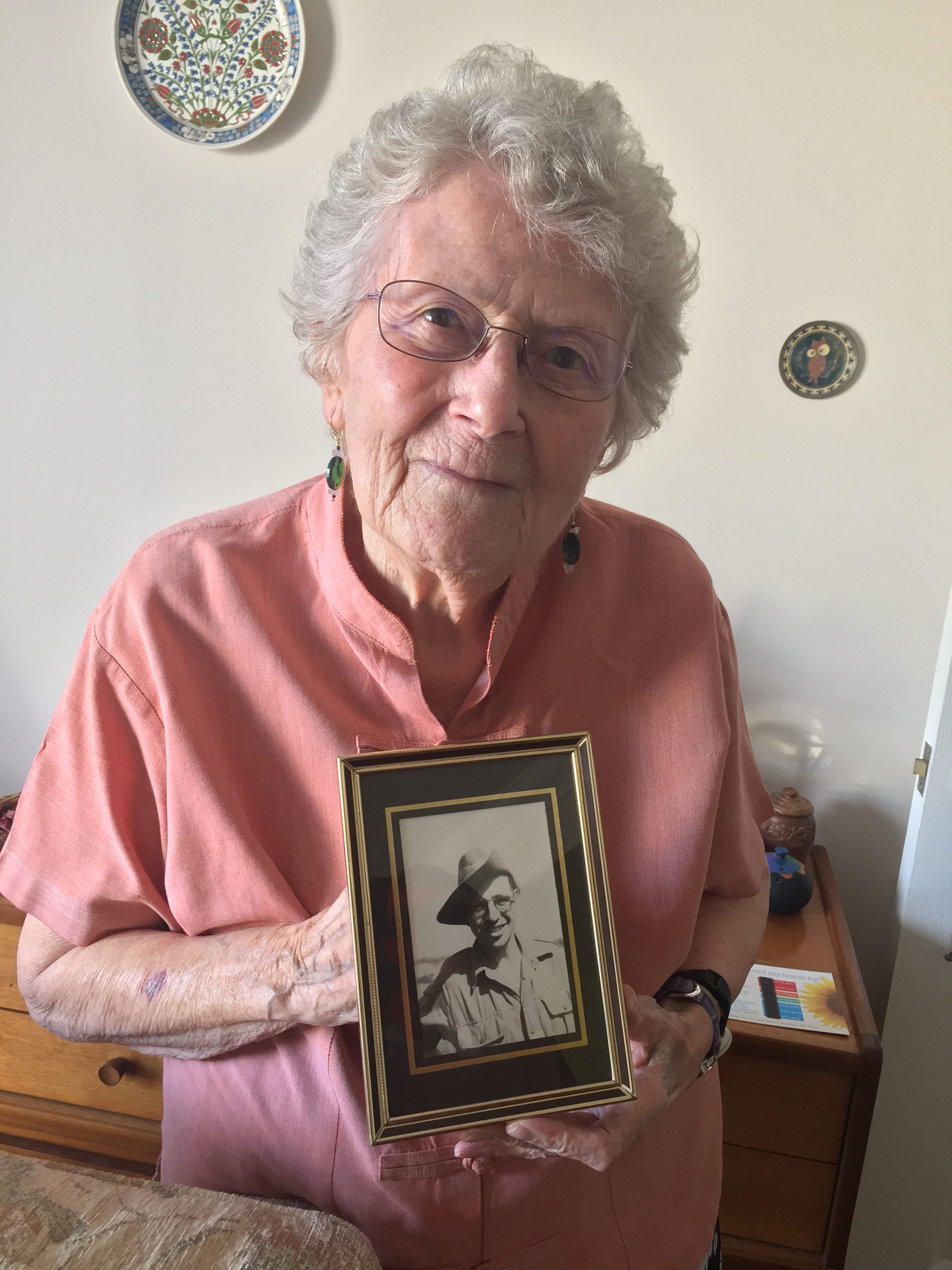 Okay, so first of all, I’d like to ask you a little bit about your background, where you were born and your childhood. Would you like to tell me about that?
Yes, I was born in North Kensington, in Tabbal Road. That ran parallel to Ladbroke Grove, and I lived there until I was about six. I had two older brothers and, eventually, we moved to Shepherd’s Bush. I went to my first infant school in North Kensington and then we moved to Shepherd’s Bush and I went to Wormholt Park School.
And your parents?
My parents … Do you want their names?
No, not necessarily. Just what were they like? What did they do?
My father actually worked for the Stationery Office. At first, he was a paper worker, paper cutter, I think it was called, and eventually he became manager of the Stationery Office shop in Kingsway, a long time afterwards, of course. He had been in the First World War. He volunteered at the age of eighteen, and you might be amazed when I tell you he was a pacifist for the rest of his life.[1] My brothers were not allowed any war-like toys. And eventually, because I became a pacifist mainly through him, I think, eventually I said, “I can’t understand why you volunteered?” He made this amazing reply: “I joined the Army to convert them to socialism”. So, you could say that was one big failure.
My mother was actually born in Wootton Bassett, in the West Country. Her father was a publican, and he eventually became the publican of the Cross Keys, which you’ve often seen when bodies have been brought back from Afghanistan, but not, of course, in his lifetime. But, I visited there quite a lot as a child, and I always remember the smell of this pub. It always smelt of musty upholstery, and you would recognise the same smell in some old cinemas in my young days, too. In my young days, there were also spittoons around. My mother’s mother had died when she was only eighteen months old but my grandfather married three times, so she had older sisters who were almost substitute mothers to her. Then, eventually, my grandfather married a third time, and his third wife was even younger than some of his daughters from his first marriage. So, I always say that I have hundreds of relations around the Swindon and Bassett area, but I don’t know them anymore. [Laughter.] The ones I knew are no longer here.
So, you grew up surrounded by a lot of family?
Well, I was sort of the town girl and used to go down there and stay with my country cousins in school holidays, so I was a bit of a mixture. I can remember eventually I got old enough to be able to be sent down by train and in the charge of the guard. I don’t know how they managed to let my parents know I’d arrived safely because none of us had phones, so I suppose they waited for the post. I can always remember, as we approached Reading on the train, coming back to Paddington, all those biscuit factories and also the sooty smell of London, the smoky smell of London, and I was always pleased to get back.
So eventually, in my day, you didn’t do the 11 Plus, but some children did the scholarship. And I did take the scholarship [among] a few children at my school, but I only did well enough to pass [and] to be recommended to go to what was known as a secondary school then, but they were sort of the next scale up, if my parents paid for my books. I’m afraid, I actually heard my mother say, “Well, she’ll be doing alright at a central school, after all she’ll probably only go and get married”. [Laughter.] Which, I’m afraid, happened. But I went to the central school, and I don’t know if you’ve even heard of central schools. They were a kind of middle system of education [for] children who’d done quite well at elementary schools, but not well enough to go on to what would be termed grammar schools. So, I left school at 15 ½, having taken no exams, but I learned to type at school. We stayed on after school and I very quickly became a touch typist, which you never forget. I can go on my computer after all these years.
My first job was at Harrods, and I worked in the fur storage department. We were two floors under. Well, there’s no fur department now. Two stories underground, and we were locked in because of all these valuable furs. There were six young men who were porters taking furs up and down to the fur department and they, sort of, protected me. I think I was very naïve and introverted, really, and they were very protective towards me. Eventually, I didn’t want to stay there, and I eventually did get a job in the Civil Service when it was just pre-war, and I worked in the Ministry of Supply in Westminster. When the war started, we all had to have a suitcase ready, and I had to report to Kensal Rise Station each morning, and eventually they said, “You’re not being evacuated. You’re part of the skeleton staff in London, so report for work tomorrow”. So, that was how I managed to stay in London for the whole of the war, and we all cared for each other. When the Blitz started, we would be late getting into work, and you never knew which way buses were going, but we could never really get down to work until everyone in the office was there, and sometimes they arrived very late.
How old were you when war broke out?
Seventeen. Nearly eighteen by then. Then, eventually, I decided that I didn’t want to sit for goodness knows how long typing schedules for tanks to Russia all day long. The surprising thing is, myself and another girl in the office, we were quite close friends [and] we were chosen to teach all the extra typists that we had in, and some of them, I’m afraid, couldn’t type. I remember I had to teach one woman who was extremely hard of hearing. She had a box, then, that she put on the desk, and every time I was trying to explain something she’d done incorrectly, she would switch it off so that she couldn’t hear me. I got a bit tired of this and I thought, “I don’t want to do this forever.” But it was a reserved occupation, and I had decided that if I was going to see this war through, I wanted to have as little to do as possible with killing people, so that was when I decided to do nursing training. I got accepted in an L.C.C. Hospital, Paddington, which no longer exists. It’s not St Mary’s. It was in Harrow Road, and I started my training there.
And what was that like?
Hard work. [Laughter.] Before a very short space of time, there were hospitals known as emergency hospitals, and they were outside London, and they were for long-stay patients or military patients. So it was part military, but we all had to go down there in groups from London hospitals. I was there in Epsom. That’s Horton Emergency Hospital, which had been a mental hospital, as they were called then, and some of the old patients were kept on doing the menial tasks, doing the gardening, and the laundry, and everything. It was quite pleasant there. I quite liked Epsom, although I did used to go up to London quite a bit. [Laughter.] It wasn’t that difficult, and I remember I always sat in the Ladies Only carriage going back, and they don’t exist anymore.
Then we went back to London and it became even harder work.[2] Not so much because of the Blitz, although, of course, it was pretty difficult during the V-1s and the V-2s, that’s the doodlebugs [V1s], as they were called, and the rockets [V2s]. I became a theatre staff nurse, eventually, but I wasn’t a staff nurse until the war ended. I trained after I finished my finals, which was 1945, just as the war ended. I became a theatre staff nurse. Then the lovely theatre sister who trained me left, and we had a new theatre sister and she didn’t want anyone who had been trained by her [the previous theatre sister], so I went back to being a ward staff nurse.
I had actually known my husband by sight when I first worked at Harrods. He worked in the advertising department, and I actually knew my father-in-law in those days before I knew my husband because my father-in-law was the manager of a town despatch. This consisted of sending out vans from Harrods. Lady so and so would ring up and say, “I need my mink coat tonight. Please will you deliver it to me”. And it would be up to him to deliver it. So, because I was the junior member of staff in the fur storage, I was always sent to Mr Eggmore, “Take this to Mr Eggmore and tell him Lady so and so wants it”. And he would shout at me, and he’d say, “How can they expect me to find a van”. [Laughter.] He always did it, of course, because he was a little bit of a coward. Lady Burbage and [Sir Richard] Burbage were the managing directors then, and he would kowtow to them. He’d been a buyer there before he was the town despatch manager, and eventually, when I got to know him as my father-in-law, I always used to think it was so funny because he was absolutely hen-pecked at home. I used to think of this man everyone used to … “Oh, I’ve got to take it up to Mr Eggmore. I’m not taking it.” [Laughter.]
Then I finished my training during the war, at the hospital, and I had met my husband again. Strangely enough, I saw him, and this was all very odd. One of my brothers was in Italy, and he’d come back and got married after the war ended, but then had to go back to Italy. We were sitting in the forecourt at Paddington Station, as it used to be, this great big square area, waiting for him to arrive, and I saw a young man and a young woman walking across, and I said, “Oh, I know that man. He works at Harrods. He’s our despatch manager’s son. Oh, it’s lovely to see he’s back”. And it was strange because I was then pointing out to my parents their future son-in-law, only they didn’t know. Eventually, I went to Harrods Club with a friend who still worked at Harrods, and my husband worked at Harrods before the war and he had returned as well. We used to go down to Harrods Club in the evening, and it was only tuppence a week when I first worked there.
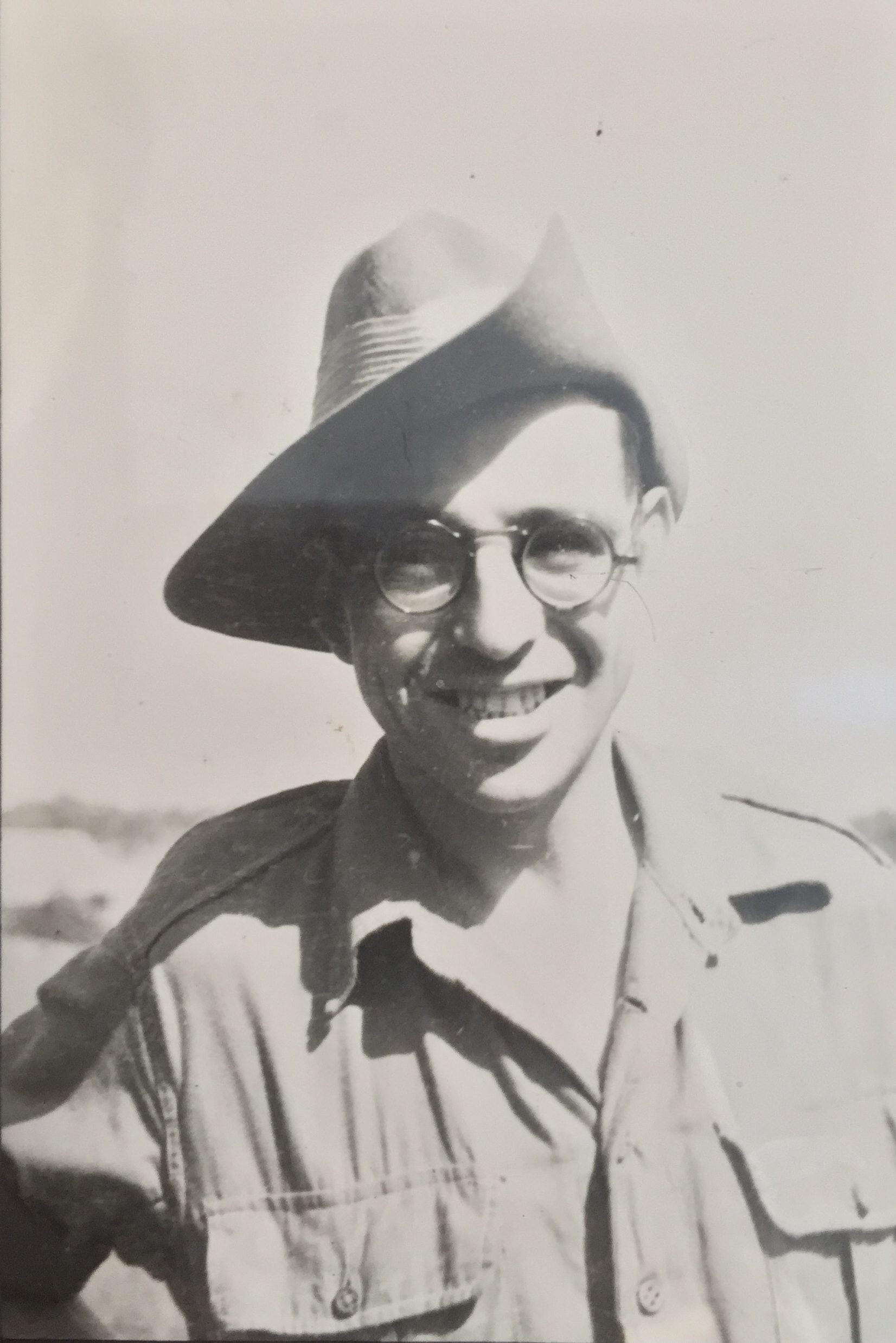
I used to go with them after the war, occasionally. I had a Saturday evening off, and I was going with two friends to Harrods Club, and we went in the bar, and there’s one young man there, and these two young men greeted each other, as they did, “Ah, great to see you safely back”. And these two greeted each other and we spent the evening together. As it happens, my friend’s mother, who had been a Polish refugee long before the First World War, she decided that she was learning to drive and Reg, the young man who worked at Harrods, was teaching her, so we had a car. Nobody had a car in those days. So, we had a car and we drove into Harrods Club, so we gave Dougie, my husband[-to-be], a lift to Hammersmith, and that was it. I just thought, “Well, okay. He was nice”. And Reg said, “You want to be careful. You’re doing alright there, Joan”. [Laughter.] I said, “I know that! I met him before the war”.
Anyway, I was working on the children’s ward and I got on very well with the ward sister there. I loved it on the children’s ward. I loved bathing the babies every day. I was a staff nurse there, and she came in on Monday morning with a big box of red carnations, and this was from Dougie, who I’d only met again that [Saturday] evening. He used to hedge his bets a bit. But I don’t know how I managed to thank him … Perhaps I got him by phone. I can’t remember that. But we did meet the next Saturday, but I had to meet him at Hammersmith Broadway, and he was with two friends at the Clarendon Pub – I don’t know if it’s still there – in case I didn’t turn up. But I did turn up, and we went to the Kensington Odeon and we saw “A Matter of Life and Death”. I remember that film. From then on, we saw each other all the time, when we possibly could.
So that was your first date?
Yes.
And his name was Dougie?
He was seven years older than me, so, of course, he’d been a young man before the war, and there was such a difference as well: those who’d been a young adult and those who had their adolescence, more or less as I did. There was quite a difference, and it was the same with my two brothers as well. We went out together, and I think we only went out two or three times and he said, “I think we’ll get married in about six months’ time.” And I said, “What are you talking about? We’ve only just met”. And we did, actually.
He didn’t actually propose?
That was the proposal. [Laughter.] Actually, my parents were not disapproving of this, strangely enough, and so I used to go to his house, eating their rations, and he used to come to our house, eating our rations. Because he lived in Heston. It was his father’s house that we lived in in Heston when we got married in 1947, and then David, my son, was born in September 1948, but his first Christmas, we went to my parents. My mother-in-law died six weeks after we got married, so I never really knew her. She was rather sweet. So, we took my father-in-law with us to my parents’ home, and Dougie had a heart attack on Christmas night, I’m afraid. But, as it happens, there was a doctor living in our road, and … this would never happen now … my parents went along and Dr Ross came along, and they became friends, the two of them and he said, “What on earth were you doing in the Army? I wouldn’t even pass you for a life insurance. What were they thinking of having you in, because you’ve got mitral stenosis”/ Actually, he did know he had mitral stenosis by this time.
So, before that … What was he doing in the Army?
Oh, right. Now, I never understand this because I never got the full story and strangely enough, I was looking at all the papers last night. He was a fantastically intelligent, creative young man, and he was put in the Pioneer Corps, and that was where all the ones who were really a bit mentally retarded were put, and I’m afraid I had suspicions. Now, he wasn’t Jewish, first of all. I must say that. But people thought he was Jewish. He had very swarthy skin, and you know people have these pre-conceived ideas, and in the early days of the war, he was treated in a racist, anti-Semitic way. People used to come up to him and say, “Why aren’t you in the Army? Our boys are fighting for your people”. Now, what do you say when someone gives an anti-Semitic remark like that to you when you’re not Jewish? I mean, he was never going to say, “I’m not Jewish”. Because he knew they would probably say, “You’re a liar”.
Strangely enough, my friend, who I’ve already talked about, with the mother who was Polish: she was Jewish, so I’d grown up with Jewish families. I used to go to their home on Atonement Day, and I would do the shopping because they weren’t allowed to touch money on Atonement Day. I used to go to all their festivals, I went to their weddings, so I knew lots of Jewish people who had blue eyes and fair hair, but because my husband’s hair was virtually black, with very, very, dark brown eyes, and he did have a slightly larger nose and people actually thought he was Jewish. I did actually say to a friend in later years, in Bath, actually, “Do you think that he was put in the Pioneer Corps because they thought he was Jewish?” And he said, “Yes, quite likely”. Now, he had rheumatic fever as a child and it affected his heart, and he was very, very short-sighted. That could only be the other reason for not putting him in an active regiment, but somehow or another, someone must have noticed that he should not have been in the Pioneer Corps, and he was then put into a unit where they were all creative: artists, graphic designers, printers. And it was just right for him. He did spend the war using his talents as a draughtsman, and he was more of a draughtsman than an artist.
In this country?
No, in India, and then Burma. He was in Burma, so I’ve been to Burma, which I’ll mention in a minute. They were in India when the war ended and then, of course, all of us suddenly remembered that there was still fighting going on in Burma because it was known as the “forgotten army”. They were sent to go right up to the north, Kohima, and they went into Burma, and they went all the way down the Irrawaddy River with their equipment, their printing equipment, on a boat, and arrived in Rangoon. And then they were doing map reproductions. So, he frequently went up taking photographs because they needed new maps nearly every day, so they were making maps. He obviously was with the right people for him. Some of them were much older, but they were within call-up age, and they were using their talents as artists and designers, and that was just right for him, really.
He was the sort of person who really should have been somewhere like Bletchley Park. He did the Telegraph crossword, which they used as a test. He played bridge. He did all those things, but, despite that, he was put in the Pioneer Corps, which was really where they put people who really couldn’t cope with being in the Army and learning all the drill, but that worked out. So, really, I have to say, he didn’t have a terrible war. I mean it was pretty terrible getting into Burma, but they didn’t have any casualties. They did have one death, and that was one of the local people on the boat going down to Rangoon. Then, of course, when the war ended. He was okay. They got the prisoners of war back first, and also the serving men who’d had an awful time. So, he didn’t get back to this country until well into 1946, actually.
So, how long were you apart from each other?
I hardly knew him then because we weren’t married until after the war. I just knew him as someone who worked at Harrods, who was the son of Mr Eggmore. He got back to this country in 1946, and got his job back at Harrods, so he was working at Harrods when we met again at Harrods Club. Sorry, I’ve gone backwards and forwards a bit.
Oh yes, Dr Ross, who lived in our street and came to see him, said, “I’m going to get you into the National Heart Hospital to see what they can do for you”. And he was sent to National Heart Hospital, and they actually said, “Well, he’s got valve disease”. And at that time, there hadn’t been any heart surgery. Whoever dreamt that they would do heart transplants, but Dr Brock, who was knighted eventually, had started repairing valves, and I had a letter from him to say that he’d done six quite satisfactorily, and these people were having a much better life. They were mostly females, as it happened, but he said that he would consider Dougie for his next valve repair. But it was too late by then.
He’d been home from the National Heart Hospital for about a week, and he wasn’t getting any better and quite suddenly, one evening, he really became very ill, and I could actually hear his heart beating. In those days, you rang for the doctor, and the doctor came and sent him straight into West Middlesex Hospital, and he had bacterial endocarditis. No cure at all then. Eventually, streptomycin would have helped, but penicillin doesn’t help, and I was told that he wouldn’t recover, so he died after about a week, which was a pretty awful week because I had a young baby as well. My poor son was parked out to goodness knows who would look after him while I was going backwards and forwards to the hospital by bus. Three buses I had to get to get there. No-one with a car who could take me, and I wasn’t with him when he died. He died one night. I didn’t want to leave him, and, strangely enough, my brother and sister-in-law came to visit him that same evening, and I said, “I don’t really want to leave him, but I don’t know what to do. I’ve got to get back to David”.
My father-in-law was looking after him then, and my father-in-law really knew nothing much about babies. I doubt whether he could have changed a nappy. One neighbour was very useful, but it was getting quite late, and my brother said to my sister-in-law, “You could take Joan home and stay with her for the night”, We didn’t have a phone but a very kindly neighbour allowed me to use her phone, and I went off to make my usual phone call. I said to, I can’t remember the lady’s name, I said, “I’m afraid to ring up. I’m afraid of what I’m going to be told”. And she did the ringing for me, and she told me that he had actually died in the night, so that was it. He was my father-in-law’s only child and, yet, my father-in-law was really very kind. He was sort of kind at first, but eventually, I think, because he’d retired by then, he was enjoying himself going out playing bowls and things, and he wasn’t really all that interested. He was more interested in me, strangely enough, than in my son, who was his only grandchild.
David never really felt close to his grandfather. He was very close to my father, and that’s where he learned all about trade unions, from my father. My father was also Father Imperial for the chapel of the printing union, the printing paper workers. It doesn’t exist anymore. So, he was brought up in quite a union background, and I do often wonder how my son might have developed because my husband was actually talking about sending him to a private school, and I was horrified at this. I thought, “We’re going to have some battles over this. I don’t want him going to a private school”. [Laughter.] And, I do often wonder, “Would David be the same person?” I have always thought that the tragedy was worse for my son than for me, to grow up without a father, who he didn’t remember. He had absolutely no memory of him at all, and it was obvious at first that he missed someone. There was something missing from his life. You know, he was always looking around, and that sort of thing, “Where’s that person gone who was my dad?” Because he didn’t do things like bathing him, and things like that which fathers didn’t do much in those days.
Obviously, my son must have got his intelligence from his dad because we eventually moved back to North Kensington, and he went to a school called Oxford Gardens School. I don’t know whether you knew Oxford Gardens at all? Which was considered to be a very good primary school, but one side of it was a terrible slum area and the other side … We moved into a fairly lower middle-class house, so he mixed with all sorts of children at this school, and he was fortunate enough to have his first teacher. He went to a day nursery while I was working because I had to go back to work, and he mixed with all sorts of children at school, and he did very well, and he was with the same teacher, and each year she moved with them, so she had ten children that she managed to keep, and they became absolutely devoted.
Now, I’ve got to go back again. When he was born, I had to go in hospital to stay because I had very high blood pressure, and I met a young woman in there, and our sons were born on the same day, and because we’d been in the annexe together, they put us together. I had all sorts of complications, but I was put in with her and she went home after about three days. John, her child, weighed five pounds, and my son weighed ten pounds one ounce. I didn’t see him until he was three days old, which I’ve always blamed for making him so independent. He’s never been a clinging person, and I’ve always blamed that we never met until he was three days old. And, I think, with my brothers, I’d known them all my life, but I haven’t known my son all his life. [Laughter.] I know I was getting a bit depressed because I thought there must be something terribly wrong with him. It didn’t matter that my parents said, “We keep seeing him. He’s lovely. He’s beautiful”. But I hadn’t seen him. I was still unconscious and, eventually, the others in my ward of four, they’d gone, and I was the only one left there, and they said I couldn’t go home yet: “Your stitches are septic”, and all the rest of it.
A young woman doctor, and there weren’t many young women doctors, happened to pop in and she said, “How are you? Where’s your baby?” Because the babies were with us, and I said, “I haven’t seen him yet”. And she said, “Is your baby that very large baby?” They never even put a label on him. They had him in the premature babies’ unit, but never put a label on him. They had to send to the children’s ward for a nightie, and I hadn’t met him. And she said, “How could they do that do you? What nonsense. I’m going along straight away”. And she came back with this large baby with his head lolling on one side and she said, “Meet your son.” [Laughter.] “Oh, yes. Hello.” And he stayed with me forever after that, and I used to talk to him, and I used to tell him all sorts of things by myself. Strangely enough, I did examine him all over, and the doctor said, “How could the ward sister do that?” But they did those sorts of things, and nobody ever said, “What a terrible thing to have done to you to not even see your baby or even taken you to see him”. And there was I, a trained nurse, and I was attending a special clinic for nurses as well when I was pregnant, and they didn’t discover how large he was.
So, we got to be quite friendly, I suppose, before we went home together, but I was very depressed for quite a long time. Then, all of a sudden, my husband bought a puppy as a present for me. Oh dear! My mother was furious about that, having a puppy to train at the same time as a young baby. Although, I have to say, my son was very little trouble. He slept all through the night. He was so used to being alone, I suppose, he spent three days without anyone petting him in any way, so he wasn’t difficult to put down and go to sleep. Sometimes he woke up in the middle of the night, but not very often. [Laughter.] So, that wasn’t too bad, and then I began to feel better, and this is very strange … I’ve told my son about this and I feel daft remembering this … I remember it was about this time of the year. The blossom was out on the trees, and the dog was getting a bit sensible, and I used to have him at the end of the pram, and people would stop me and say, “Oh, I haven’t seen your baby. Oh, what a lovely puppy”. And he was a golden Cocker Spaniel, and I’d realise they’d gone off and they hadn’t looked at the baby at the other end.
It didn’t bother David. He was cooing away there quite happily, but I remember on this particular day, the sun was like today, and the blossom was on the trees, and we had it all down this road in Heston, and I was pushing the pram, and the dog was walking along quite sensibly, and things seemed to be going right, and I felt really quite happy and better. Quite suddenly I was better. A man came along, he was probably only middle-aged, but I thought he was older, and he said, “What a lovely picture! You and your baby and the dog under the blossom”. And I always remember that because that really lifted my self-esteem when I’d been feeling so down, and I’ve no idea who the man was, but he made me feel better. So, that lifted our day, but that didn’t last for long. We managed to get a holiday on the Isle of Wight, and we were there on his first birthday, actually, David. So, we did manage to get a holiday on the Isle of Wight when he was nearly a year old, and then things went down from there really.
That was the only holiday you had all together?
Well, we’d had short weekends down with some friends in Eastbourne, and that sort of thing. We didn’t have a proper honeymoon. About two or three days in Eastbourne, I think.
You haven’t mentioned much about your wedding?
Well, of course, I would have liked to have just got married, but you know what mums are like? So, we had to have lots of people and, “We must invite her. We didn’t invite her”. [Laughter.] As long as I had a few friends there and Dougie had a few of his friends there. His mother couldn’t come. She wasn’t well enough, and I got married at St John’s Church Notting Hill in Ladbroke Grove. We did have a church nearer to us, called St Helen’s Church, but that had been bomb damaged. It was repaired eventually. So we got married at St John’s Church, and the reception was at my home, and they managed to do all of that. They managed to get food and everything, and neither of us wanted a great big thing. It wasn’t just me. Of course, I had to have a white dress [laughter] and we learned that they were hiring out dresses from Lime Grove Studios, so I had a rented dress. My best friend, I wanted her to be a bridesmaid, but for some reason … She didn’t object, my family didn’t object, but someone raised some objection because she was Jewish, I’m afraid.
So, eventually, everyone thought I ought to have a bridesmaid, so I had a little relation of Dougie’s, who, strangely enough, her father had been in the Navy, his cousin, and he’d been killed during the war. So, she was on her own, without a dad as well, but I’d lost touch with her mother, I’m afraid, because when you’re so busy working all the time, you do lose touch, and I’ve lost touch with people since I’ve been here. I’m afraid most people who were my friends are no longer here anyway, but I do have some nice friends locally, some nice kind friends.
When you were with your son and he was obviously very young … Can you say a bit more what it was like bringing up a child as a single mum?
It was very, very difficult. I have to say, I was a bit stubborn here. My mother wanted to look after him. At first, my friend, Leah, her mother worked for Jaeger’s work rooms and she trained us, me and Leah, who had a little girl by this time, to be finishers for Jaeger’s, and I learned how to do finishing. I got six and six a dress, and I could take it home to do, but it became very difficult. I lived with my parents for a while. I left my father-in-law’s home and lived with my parents.
My mother was so possessive. She was even possessive before I had David. My sister-in-law had her son, well, he’s still around, let’s call him my nephew, eleven months before David. She came home with this baby, Colin. I hadn’t had David then and my mother took him over. My mother did all the bathing, and she said, “Oh, she won’t be able to do it properly”. My mother wasn’t very nice to her daughters-in-law at all. And my daughter-in-law tells me that I’m the best mother-in-law in the world. That’s because I’ve never bossed her around.
So, I decided that, perhaps, I don’t know, I think, maybe for our future, I did do the right thing. I didn’t want my mother taking over, and I did decide to go back to nursing which was, perhaps, a mistake because I found it very difficult. So, I gave up the sewing job and went. You could just get a job, go to the hospital and say, “I’d like a job as a staff nurse”. And they took you on. So, I decided I would like to work part-time. I went to Hammersmith Hospital and they took me on, and they’d only just started with part-timers, so they took me on as a part-timer.
How old was David?
David would be in his second year by then. He was nearly two when I decided to go back to nursing. Just about two, I should think. So, I worked part-time and, at first, well, the part-timers grew, so, the full-time staff became a bit resentful to the fact that that meant they had fewer evenings off because we mostly worked 8:30 to 5:00, or 3:00, or something like that. So, they decided that we all had to do one evening a week, but I didn’t have to work at the weekends, only if there was something terrible going on. So, I worked Monday to Friday, but I had to do the one late evening which meant I did have to let them look after David, but that was alright, just for an evening. But I managed to get him into a nursery, and the strange thing about this is: David’s very first day in the nursery, he was used to being looked after by other people, so there was no clinging to me or anything like that.
I deposited him at the nursery and as I was coming out, there’s this young woman coming in with her little boy, and it was John, who was born the same day as David in Middlesex in Twickenham and he was back there living, and he was going to the same nursery. Also, the other terrible coincidence was that Johnny’s dad had been in the Navy, but he was discharged through ill health, so he got a pension straight away and our two husbands used to meet when we were both in hospital in the annexe, and they’d go off and had a drink together, and they became friendly. But, of course, I hadn’t seen them since those early days in hospital, and Johnny’s dad had also died. He just went to work one day and never came back. That was a hard thing. So, Johnny was at the nursery with David, and they became very close friends. They were close friends all the time they were in primary school, and they were in the same exclusive ten that Miss Pearson had in her select few.
I do know, though, that David fell in love with this teacher, and when she was getting married, she told them her married name, and I can’t remember what it was. They went back after she’d got married, and the children were calling out their names. She told me this, and she would say, “John Henwood”. And Johnny would say, “Yes, Mrs Smith”, or whatever her name was, and then she would say, “David Eggmore”. And he would say, “Yes, Miss Pearson”. He refused to call her “Mrs”. Eventually, she left the school, perhaps she was pregnant, I don’t remember. But she lived in the suburbs somewhere, not far away, say, not as far as Windsor, I think. And, eventually, when she left, the two of them actually travelled together on their own to spend a day with her. Well, we had all these arrangements, one of us saw them on the train, and she met the train and that was their first travelling alone when they were only about seven or eight. Maybe they were just going into the Juniors, as it was called then.
David, was never one for going out to play. I used to have to push him out almost, but we eventually got a flat from the Housing Association, which, strangely enough, backed on to my parents’ home, so we could go over in the mornings to my parents, and this was just a lovely coincidence and we were very happy there. Things got better with my parents, and my mother then decided that she shouldn’t be so bossy about me and my son. So David used to climb over, and Johnny would come and play in our back garden, and they were still quite friendly the whole time at junior school, but when they left, David went to a direct grammar school. I got a phone call at school one day, at work, well, I was in the Civil Service then, while he was at school, to say could I go and see the headmaster. I went to see the headmaster, and – I hope my memory serves me right here – he told me that David, with two other children in the whole of London, had got 99% for their 11 Plus, and he said, “I can recommend him for Christ’s Hospital [School]”.
I thought about this. I didn’t want him to go to a boarding school. I didn’t think he’d be happy at a boarding school, so he then said, “What about Latymer Upper?” That’s Hammersmith. “Or City of London?” Well, City of London would have meant a much longer travel, and so he went to Latymer Upper. One of the teachers at the primary school, who was a teacher who did the emergency training after the war, with two other teachers there, and they were fantastic. He said, “Tell him to let me know what university he gets to”. So, he did, eventually. York he went to and he did English literature. I’m afraid he should have got a First, but I don’t think he worked hard enough. My granddaughter has got a double First from Edinburgh, and so I always like to think she’s inherited her grandfather’s genes as well.
All this time you were working? You mentioned the nursing, and then the Civil Service.
Yes, I started nursing and, as you can imagine, it was difficult enough keeping myself because I knew absolutely nothing about applying for a War Widows’ Pension. Nobody ever mentioned it anywhere. I got a Widowed Mothers’ Pension, but – this sounds ridiculous – if you earned more than £2, it got subtracted from the pension and, believe it or not, I didn’t get as much as £3, but it was worth me working and losing something from my pension for, say, about ten shillings or fifteen shillings extra. It actually made a difference. Then I thought, I can’t carry on like this because I’ve got to look after this child and buy him shoes and everything. So I thought, I’ll just have to give up nursing, and I think I must have gone to an employment agency, and they said, “You’ve been a typist in your time. Would you like to take a test?” So, I said, “Yes”. And they said, “Would you be interested in going back in the Civil Service?” I then got a job in Shepherd’s Bush, and I could actually walk there because it was almost quicker than going by train. If I’d gone by train from Latimer Road Station, I’d have gone to Goldhawk Road and I would have had to walk all the way back. So, I used to walk to work, which didn’t do me any harm.
I worked in the Inland Revenue and I worked there for twelve years, and it was so boring, and I’d completely forgotten. This was my plan: I wasn’t going to establish myself, and I thought that, eventually, I would do something else. I did all the proficiency tests which brought in a bit more money, and I trained as an audio-typist in the Estate Duty Office, not the Income Tax Office. When David got to university, I thought, “Right, it’s my turn now”. And, of course, he went to university at the right time. Whoever thought that those days would be so much better than today? No fees and not a bad grant, either. He lived on his grant, and he drove a car as well. I think he got a little bit of money in giving lifts back to London, but he did drive a car the whole time, and he passed his test before I did, whilst he was still at school.
So, we were alright. And can you imagine? This is what happened and my granddaughter: although she went to a Scottish university, other people had to pay the fees and kept her as well, and this is all these years later and you think that those were the sort of golden days, almost. I remember he got grants for other things. He helped with a dig on one of the Orkney Islands, and he got a grant to cover doing that in his holiday.
So, you said it’s your turn now?
Then I was going, and I had already started going to some classes at the City Literary Institute. Have you heard of that? It still exists, more for adult education and giving you proper courses. I’d done a drama course and then, more or less at the same time, this course came up called, “Fresh Horizons”, and this was for people, mainly women, who’d left school when they should really have stayed on, and so I started doing all these refresher courses. We even had a ballet class, which was lovely, and that was to keep you exercised, and there were showers there that you could use afterwards. Eventually, after the first year, I had to see the tutor, who probably wasn’t much older than me, and she said, “Have you decided what you would like to do?” And I said, “Well, I’ve done nursing, so, I would like to do some kind of social work. So, could you tell me what I could do?” So, she said, “Have you ever thought of teaching?” And I said, “Well, of course I have, but I haven’t got the qualifications”. And she said, “Yes, you have. It’s open now to mature students”.
And this all happened at the right time and I remember I had to go to the University of London and take this what I call a giant IQ test. It lasted forever and you kept turning the page. And you never were told the result. I don’t know what the percentage was, and there were some questions that I found quite difficult, but perhaps I’d make up for it in the next round, and I think that’s probably what happened. They decided that a lot of us there … And there was a great mixture, there were people older than me, even.
How old were you then?
I was early forties by then. Perhaps about 43 by the time I started this, but there were people older than me. People who’d been in the police and retired early and decided to do teaching, and quite young girls, even, who’d left school, and people like me, my age, who’d left school before the war, and people who’d had a much better education than I’d had, but hadn’t got the matriculation, as it was known as in those days. So, then once you’d been told that you’d passed it, it was then up to you to get in. So you were given three choices, and I chose … it was called Battersea College of Education but the college was at Manresa House, the other side of Richmond Park. It had been a Jesuit college and it was there where Byron got stabbed by Lady someone or another, Lady Caroline Lamb. That building.
I loved it there. I used to drive through Richmond Park every day and the reason I chose that one which took mature students, well, I think they all took mature students by this time, was because they were going to do a drama course, which is what I was interested in. I’d always been interested in the theatre. So they weren’t doing it then, but it was going to start next year when you had to start a main subject. So, I was there right at the beginning of this drama course, and I was the only oldie there, so I was there with all these youngsters. They were great. They accepted me as an old person, and I did feel a bit of an outcast amongst them sometimes, but I did all the things that they did. I didn’t pass with glowing colours at all, but I passed. Then, I had done a bit of supply during the school holidays, the college … No, I think we must have started our holidays before school was out, so I’d only done a very little bit of supply, which you were allowed to do in your last year.
So then I was just given a job, and it was almost like when I went back to nursing. There was a vacancy at Norwood Green Junior School, and I got in there. Well, by this time, of course, my son had finished university and was back in London. I was living in what had been my father-in-law’s house. He had died in the meantime, but David didn’t particularly want to live there. Because, of course, with my husband dying, it became David’s house, not mine, because David was my father-in-law’s next of kin, so it didn’t become my house, but I had to do all the work about it, doing all the going out and swearing by oath, and all that kind of thing. David then thought that he’d like a spell out of London. I did my year’s probation and passed that, and I had decided that I would like a spell out of London, so I did give in my notice, but I was taken on immediately at Heston Infants School for a year, for a term’s supply, because their teacher was going into hospital, so that was when I met the younger children, and I certainly loved teaching the younger ones, although I quite liked the juniors too.
So, I eventually decided that I would find somewhere, and David said, “I’m not selling this house. So [until] you’re sorted, I’m not going to sell the house”. So, he had to sell it. Of course, he was over 21 by then, and I got a job, eventually, down in Plymouth. I had a friend who lived in Plymouth, which was a connection, and I’d known her in London, as well. I couldn’t get a job in Plymouth, but then I looked further afield, and I thought, “Well, Cornwall is only just across the bridge. I’ll try Cornwall”. And I got a job in Saltash Junior School in Cornwall, and moved down to Plymouth. I managed to get a flat. Well, you wouldn’t really call it a flat. It was an annexe in a Georgian mansion in Plymouth, and when I told people where I lived they said, “But that’s a Georgian mansion”. And I said, “Yes, but I live in the servants’ quarters”. And I had to use the back door. I think the owner found this was economically better to include me in his rates rather than to have separate rates.
So, I had to use the backdoor, and he had to have my post, which did annoy me slightly. Again, I thought, “I don’t want to live like this”. It wasn’t a particularly nice place to live, but I was allowed to take both my cats, so, I decided I would try and buy a house. In the meantime, David had given me some money from the sale of the house, so that we could both buy a house. By this time, we were financially alright and, at last, I’m a teacher and he’s got quite a good job, and a good income, and he was paid a salary from Camden, but he got extra from the union because it was one of the biggest branches of Unison in the country. It had thousands of members, and he had a staff, even. So, by then, we were financially alright, and I found a little house in Plymouth which I quite liked, and I liked living in Plymouth. You can get out onto the moors in about ten minutes.
But, unfortunately, I did not get on very well with my headmaster. I was a bit of a thorn in his side because I realised that I had not learned to be a yes-woman, and I would disagree over certain things, and he didn’t like it at all. I can’t blame it on the Cornish because he wasn’t Cornish. The Cornish actually treated me as a foreigner, but I wasn’t the only one there. There were three of us from Plymouth, and we all used to think we needed our passports to go over the bridge. I don’t think it’s quite so bad now, but I did have problems. The cleaner of my classroom used to complain about me non-stop if she found a tiny bit of paint anywhere. The person I got on with very well was the caretaker, who is, actually, usually the person who runs the school. He was a Londoner, and he was always on my side, but I did have some teachers there on my side. But I realised, amongst the older teachers there, who were men, they definitely went on their knees, almost, to the headmaster, and I didn’t. I thought, “I can’t stay here forever. I’m going back to London”. [Laughter.]
Which I did, and this is when I decided I was going back to London, but I hadn’t given in my notice, but I was looking for a job first. I’m not quite that reckless. I thought I would have to sell the house when another strange thing happened when I decided I was going. Some people called to see me and said, “We hear you’re moving; can we buy your house?” [Laughter.] So, I didn’t have to use an estate agent. They had lived a few doors down the road, and they had moved to South Africa and the didn’t like it, and they came back. I hadn’t known them before, but it was only a few years earlier and they wanted to live in the same street, and they called to see me and said, “Can we buy your house?” And they made an offer which was more than I’d paid for it, but houses had gone up a bit, and I’d lived there for four years. So, that was solved.
Would that be in the 1970’s?
This was 1977, and I remember it well. David and I started looking for houses around the school. Well, again, it was fairly middle-class one side and a council estate the other, but the children went to the school. So, we started off a bit too high, and they were houses that I could never afford, so we started looking a bit further away, and it was rather strange. The penny dropped eventually because it’s in Southall, beginnings of Southall, and people would open the door and say, “Have you come to see our house?” And they’d welcome us in, and then we would realise the next-door neighbours were immigrants, and they’d been told by friends, “Don’t go selling your house to an immigrant. We want more white people here”. And the penny dropped, and I thought, “No, I’m not buying your house”.
And again, it was another piece of luck. We were looking at my mother’s local paper and I was looking at houses for sale, privately, because I’d sold my house that way and it said something about the cottage near the canal in Glade Lane. And I said, “Do you know where Glade Lane is?” To my mother, and, no, she’d never heard of it. Well she didn’t live that close. I think I happened to go to the school where I was going to teach the next day, for some reason. It was holidays by this time. Well, it was only half-term. That was it, and I’d gone to the school and I said, “Do you happen to know where Glade Lane is?” And it was Mrs Gumbleton, who was the caretaker, and she said, “I live there”. And she said, “Are you looking for a house? Number so and so is up for sale”. Well, I’d also seen this advertised, so I went along and it was a bit of a broken-down, cottage so I did have a lot of work done on it, but it was my price range.
The woman who was selling it was, obviously, trying to fiddle in some way and I never again found out what it was she was trying to fiddle because she was pretending that she lived there, but neighbours eventually told me that she’d never lived there. She was saying, “We had the fridge there”. And all that sort of thing. The ceiling was brown because the man who’d lived there used to smoke non-stop, but it was in my price range and it was within two minutes walking distance to school. I didn’t have any expenses to get to school, and I was then getting a London Scale 2 salary, and then, while I was still in Cornwall, the union rep said, “Have you applied for this extra grant up the scale you can get because you’ve brought up a child?” And I said, “Well, I haven’t heard of that one”. And he said, “Well, you can just apply for them”. So, by the time I got back to London, a cheque dropped on my doorstep: £3,000 back pay because I’d brought up a child, and I was perfectly honest, I said I wasn’t a full-time mother. I couldn’t ever be a full-time mother, but they gave me this grant.
Who gave you that money?
Well, I was entitled to it, apparently. I was up the scale a bit because I’d done nursing, so that proved I’d done exams and things. I didn’t start off at Scale 0, and then I went up the scale a bit more. With a teacher’s salary, you got all these extra bits that moved you up the scale. So, I could afford then to have quite a lot of work done on my little cottage. Then, of course, I worked at the school just across the bridge of the canal for ten years. It was a First School, then, so the children I taught were actually the same as first-year juniors which I’d taught in Saltash, and they then decided to change it back, and by this time, I had retired. We were, then, strangely enough, overstaffed, and each year, the Head used to see me, and she’d say, “I know what you’re going to say, but I’ve still got to say this to you. You are over fifty. You could apply for premature retirement”. I think that’s what they called it. And she said, “I know what you’re going to say: that you don’t want to retire”.
But, strangely enough, I got red kidney bean poisoning, and I was really quite ill, and for the first time in teaching I had to take time off, and I wasn’t at all well. When I went back, I said, “I’ve been thinking about this, and I’ve been thinking about … Perhaps, I might look into this offer”. And she was very good and said, “I don’t want you to do anything in a hurry”. And I said, “Well, really, it’s totally unfair that you might have to lose a younger teacher because we are now over-staffed, when I could retire”. So I said, “If I can retire and do supply teaching, continue doing supply teaching, I think I can manage that”. And I had to go and see the union rep. He assisted on that, and he worked it all out the same as I had, what I would be getting. So, I decided to accept this, but then, of course, I was always going back to the school as supply. [Laughter.]
The same school?
Yes. I went to other local schools as well, but I quite liked doing supply teaching because you didn’t have to do all that much paperwork, and I even did nursery sometimes. And again, meeting Asian families in the nursery, you didn’t really do much in the way of teaching, but you do sort of get all the children together first. There were other people there to keep an eye on me and watching me, though I was doing the right thing. Then it came to playing with the toys because most of the children were by this time children of mostly Indian families, and I’d say, “You can go and play with the toys now”. And the little girls would stay put, and all the little boys would go and grab the bicycles and the trolleys and the trains, and then the little girls would get up and play with all the toy saucepans and ironing boards. It was really a lesson in female emancipation to come, and I used to try and encourage them.
So, when I had been in the Junior school, before retiring, a teacher of the same year happened to be an Indian, but she was unusual. She was well in her forties and unmarried. She had refused to accept an arranged marriage. They’d find men, and she’d put them off, I expect. “No, no, I’m not marrying him”. So she came to this country, and she was very independent. She wasn’t a middle-aged Indian lady doing all the housework at all. She had an older brother, who was a nice person, apparently quite well-known. He worked in America, and he used to come and see her. She was buying her own house – I think it was a maisonette in Ealing – and she didn’t like all these boys coming first, and I think she was a bit anti-man in a way. So, she said, “I’m going to start having a selective discrimination”. So, I said, “Well, yes. I think I’m going to do something like that too”. But they weren’t so bad by this age, actually, about seven or eight, but hands would go up and I thought, I’m not being unkind to boys, but I would mostly choose the girls first, but I would know the children who I ought to encourage to answer as well, but Jarinda was probably stricter than I was.
So, we made these girls so independent of boys that when I eventually retired and they’d grown up, most of them were at Reading, because they could get home. The girls at university that I would meet later were at Reading University, and I’d be driving along Jersey Road where I lived, and young women would come driving out of a side road and I’d look and I’d think, “Yes, this is what Jarinda and I did, and they’re coming first. They had learned to assert themselves.” [Laughter.]
So, you did all this supply teaching until you were aged seventy?
Yes, and I apparently ought to have stopped at 67. Well, I worked at other schools as well and I also did a bit of Teaching English as a Second Language, which I quite enjoyed. That was fun, but it was a bit difficult. I had to get to Hayes, and I even had a childminder I took with me, that was supplied as well by the council, and she looked after the children of the ladies, although we did have one man. It was mostly local schools. I had my favourite schools, and I didn’t work every day, but sometimes a term’s supply would come up and I did have a permanent half-day at my local school just across the bridge, so I kept in touch all the time. It came to the end of the school year, and I was nearly seventy. I hadn’t decided to give up but I thought I maybe had to, and we got into October and the phone rang one day, and it was the Deputy Head from upstairs, the Seniors. It all became one school, eventually, they went back to being one school again.
First, Middle, and Upper?
He rang me and said, “Do you think you could possibly come in this afternoon?” And, actually, I couldn’t, but I can’t remember why and I said, “I’m very sorry. I can’t manage this afternoon”. But I said, “I thought that you’d finished with me now that I’m seventy?” And he said, “Don’t be ridiculous. You can’t possibly be seventy”. And I said, “Well, I am”. So, I got worried and thought I would check up on this, so, I rang up the Education Department, and I said that I’d been a supply teacher and they said, “Well, actually, you should have retired at sixty-seven, but we didn’t like to tell you”. [Laughter.] So, I said, “Well, I decided that you weren’t going to employ me anymore, but then John rang me and asked me whether I could go in today”. So, I said, “Well, I’ll tell them not to ring me anymore then”.
You were still in London?
Yes, then it became very, very difficult because I didn’t live near [public transport] and would have to go under the railway, the mainline railway, under the tunnel which everyone called, “Devil’s Tunnel”, to get to the Uxbridge Road, or walk along the towing path to get anywhere near public transport, or drive to Osterley Station, which was my nearest, actually, or Boston Manor, but it became so difficult to find parking spaces. I used to do some voluntary work. I did some voluntary work for the National Peace Council, which no longer exists, and that was near the Angel, and I had to get there and I found the best way was actually spending a bit of money because my fee ticket didn’t cover the local trains, you know, the Western Region, but I could get a train from Hanwell, King’s Cross, and then a bus to do this to get to the Angel. But it became so difficult, and someone damaged the bridge over the canal, so I couldn’t drive over there, and no-one wanted to take liability for repairing it, and I don’t know if it’s been repaired now? So, that was closed to traffic, except where they allowed lorries and vans and things to go over, or in case of a fire. I think you could go over but they had these locked bridges.
I thought, “I don’t really want to stay here forever”. And I had, in the meantime, met up with someone I knew during the war, as it happened, and he was a boyfriend of mine during the war, and I hadn’t seen him for years and years, and I went to the Strikes School open day in Essex. Somewhere I’ve got a book about it. The children had gone on strike in this school in 1914 because they objected to the way their Head and her husband were being treated by the Squire, and this became a famous school. They used to have an open day and it was organised by, I think, the NUT [National Union of Teachers], and a man I knew, he and his wife were friends, they were both teachers. He used to organise a coach trip every year to this place. I don’t think it’s Ditchling. It’s somewhere in Essex, I think. And they had a big open day, but it was organised by the NUT. It was a sort of union day, and it only cost £7, I recall, and off we went there.
Now, this friend, Stan, who I’d known during the war, he was working for a Peace Service unit, and that’s how I met him. He was a conscientious objector, and he came to London to help us townies during the Blitz, so he had a pretty tough time. They were doing rescue work and First Aid, and they ran a rest centre as well, in Paddington. I knew that he belonged to the Agricultural Workers’ Union, in fact he was their Secretary for a while. That was part of the GWT, the big main union.
The GMB?
No, it was one of the big unions, and it became amalgamated with it. There’s no separate Agricultural Workers’ Union now. It wouldn’t be the NUF. That was farmers. Anyway, I had thought once or twice that I would go to the CND [Campaign for Nuclear Disarmament] meeting in Tavistock Square that Jeremy Corbyn always organised, and that was how I got to know him. He wouldn’t remember me, although he might remember the name because he possibly knows David, my son. He always organised this, and I used to look ‘round at all these old men who’d been conscientious objectors, and I often wondered, “I wonder if any of them are Stan?” And I couldn’t see anyone like him, but I went to this strike day outing. I saw a stall of the Agricultural Union, and I looked and there were about four elderly men sitting along there, and I thought, “I don’t think any of those are Stan”. But I did ask, and I said, “Do you happen to know a Stan Heywood?” And they said, “Oh, we know him”. But the man who had organised the outing overall, I’d actually met but never mentioned it to him earlier, and he had worked for the Agricultural Workers’ Union as well. So, they said, “Go and ask so and so”. And they said, “We don’t know where Stan is living, but he’s around”. So, I went to ask this man, and he said, “Have you got a shopping list in your hand bag on the back of an old envelope?” And I said, “More than likely”. [Laughter.] So, I found an old envelope and he said, “I will give this to him, and I’ll ask him to write to you”. [Laughter.] He said, “He’s living in some awful place called Nailsea, and he doesn’t like it”. [Laughter.] “You’ll cheer him up if you ring him up”. He’s probably never heard of me, this man I’m talking to, but I did eventually hear from him [Stan].
He wrote to you in London?
Yes. And what had happened, it was seven weeks afterwards … What he had done, he’d written to Stan’s house, that he’d owned in Nailsea, but in the meantime, he’d [Stan] gone to live with his daughter, so he didn’t get his post very often. All of a sudden, I get this phone call out of the blue, and it was him. It was strange because he didn’t drive, and I was going to a wedding, a Sikh wedding, as it happens, that Saturday, so I’d decided to go to Nailsea and take a pair of trousers that I bought because I knew I’d have to sit on the floor. Velvet trousers, and I needed to shorten them. I thought, “Well, I’ll go down to Nailsea”. And on the way back I was going to stop off at Wootton Bassett and stay with a cousin and shorten my trousers at the same time. [Laughter.] And I found my way to Nailsea, perfectly easily. I’d seen it many a time on the M5, where you had to come off, and it was always in brackets in those days, so I’d heard of it. But Stan was absolutely hopeless at directing anyone. He never knew his right from his left. He actually had a scar on this right thumb, and he used to rely on that, but then he couldn’t remember whether it was his right thumb or his left thumb.
So, I found my way perfectly to Nailsea itself, but his directions were absolutely hopeless. I’ve passed the comprehensive school, yes, that was okay, then I went down this road and got to the end, and I thought, “I think I’ve come too far”. So, I went down Hannah More Road, named after a famous lady who founded schools in Nailsea, and I thought, “I’ve got to ask the way”. And there’s a young man painting a house there, and I said, “Please can you help me? I’m looking for Morgans Hill Close”. And he said, “Never heard of it”. So, I said, “Well, I do know it’s near a pub called the Ring ‘o’ Bells.” “Oh, Ring ‘o’ Bells! I know where that is”. And Stan had already mentioned he was going to book a lunch at the Ring ‘o’ Bells, which is right opposite. So, I found my way eventually to the house, and it was really strange because we had been very, very close friends, and we more or less carried on the conversation we’d finished about forty or fifty odd years before, and it was really lovely.
He was living at his daughter’s. He too had had a heart attack, I’m afraid, but he’d also burnt down his kitchen with a chip fryer, and he did it twice, and that was typical of him, actually.
Was he widowed or divorced?
By then he was widowed, and I’ve missed out on another important thing. I think it was about 1954, and I was quite keen on tennis, as a spectator. I was hopeless at any games, and I became really interested in Jaroslav Drobný, and I really wanted him to win. He did win the finals, eventually, but I only heard it on the radio. By this time, David was going to school, I think. Yes, he would be going to school after Wimbledon. I decided to go to a news cinema, and I thought I would introduce him to the cinema. There’s always some cartoons, and I can see the tennis because not many people had televisions. So, we went somewhere off Oxford Street to a news cinema and, poor kid, he sat through all of that, and he was so good, so I treated him to a chocolate éclair, and he would hate me telling you this because he doesn’t eat sweet things at all.
So I thought, “We’ll go in Lyons Corner House”. And I sat him in a chair, and he was always quite good and reliable with things like that, and I queued up at this cafeteria and I’d bought myself some tea, and I could only afford one chocolate éclair. Anyway, I looked at the cakes, and I looked up about to say, “Have you got any chocolate éclairs?” And it was Stan. He worked there on Saturdays [laughter] at Lyons Corner House, and he said, “I’m sure I can find one for you”. And I often said to him afterwards, “I think you went and picked that one up off the floor because why wasn’t it on sale?” And he said, “Course I didn’t”. And I said, “That’s for my son”. Now, this was very naughty of him. He didn’t think I was telling the truth when I told him that my husband had died. I never quite forgave him for that, I mean, you know, he didn’t believe me. I suppose when you see a young woman with a child, perhaps you automatically think, “Oh, no, that’s a little bastard” or something, and he didn’t really accept it. I mean, he did eventually. But we never arranged that. He said, “Can you wait ‘til I’ve finished, and I’ll see you after I’ve finished?”
So, we went for a walk around Hyde Park. We chatted, and he told me he had two little girls. He lived in Barnett, and he was only doing this for money to live. His wife never wanted to do any work because my sister would have worked on a Saturday and my brother would have stayed at home, but that didn’t work with him. So, we just chatted, and we didn’t make any arrangement at all, but I did have some connection by post while I lived in Saltash, but I never followed it through. But it was when I saw this stall, and I’d looked at all these other old men on Hiroshima Day, and one of them was him, and did nothing about it. But then of course I did, and so Stan used to come backwards and forwards and stay up in Southall, and I used to come down to Nailsea.
Of course, I’d already decided that I couldn’t stay there forever and I thought, “I don’t want to go as far as Plymouth again, and Bristol’s not too bad down the M4”. And I used to drive backwards and forwards a lot when I first came down here. I was a guide at the Natural History Museum, and I kept that up for some time as well, once a week. So I eventually decided I’d quite like to live in Nailsea so that’s how I happened to come to Nailsea.
Did you live together?
No. He wanted to, but I saw him all the time, nearly every day, and we did go away on holidays once or twice. Actually, I mean, I had my own home, so I bought my own home, and it was only a one-bedroom house, but a nice modern one in Nailsea, and a little garden, but I’m afraid this is what happens with daughters. He had two daughters, one was fine, I still see her occasionally, but the one who still lives in Nailsea wasn’t very nice. She really thought I was going to make him come and live with me, and I actually said, “Where do you think his belongings would fit in?” It was a small house, and I wasn’t getting rid of any of mine. He had quite a nice room in her house, and she wasn’t very nice at all, actually, but I still went on seeing him, and she didn’t stop me, and I was with him when he died, actually. He was in the BRI [Bristol Royal Infirmary] in Bristol several times.
When was that?
That was from 2000 onwards he was in hospital. I came down to Nailsea in 1994, and I always say: my son got married, there was democracy in South Africa, and I met up with Stan. 1994. But I didn’t move down until 1997. I didn’t rush down here, and so I came down here to live and, again, she [Stan’s daughter] was so nasty that I’m afraid he moved out and got sheltered accommodation in Nailsea. But I used to see him all the time, and she never saw his flat until after he’d been there for about three years, which I thought was really bad because he needed help. He did get help, and I helped him as much as I could, and he went in hospital, and she never knew this. I never told her this because it was only me and his other daughter whom he told. He wanted us to say, if he had another bad heart attack, he didn’t want to be resuscitated, which was really right because he’d really had enough, although he was younger than I am now.
So, I knew that this was likely to happen, and he actually had been in hospital, and he’d only been home about two days and the warden – there was a warden where he lived – she had suddenly become aware he was supposed to be back. She wasn’t calling on him as a regular thing, so she checked whether he was back or not, and she went in his flat and found him on the floor, and she got the ambulance and rang me. I think I’d already rung just to check up every day, and I’d already rung, and she said, “Well, the ambulance is outside, you might be able to get ‘round in time”. And I did, and I went off to the hospital with him, and he was put in a heart resuscitation room. There was about four of them in this little ward and, obviously, I don’t think any of them were going to get better.
But they were lovely there and, as it happens, the daughter that lives in Burnham now, Burnham-on-Sea, she was coming down to see him, and she happened to be on the coach, and nobody had informed her. Now her sister hadn’t informed her that their dad was in hospital, so she was going to let Di come all the way to Nailsea to be told to get back to Bristol. I managed to get in touch with her on her mobile. She wasn’t answering it at first, before she got to Bristol, so that she could come straight to the hospital. I left them to it that day and then the next day, which was the Saturday, I was going because there were various things he’d asked for me to collect the day before, which I went to do in his flat. And it was pretty obvious that he wasn’t going to survive.
So, we did talk, all of us, for a while, and the two of them actually did go off and have a little chat together, and I told the staff nurse about my 21st birthday, when I was nursing in Epsom and he was working at a Peace Unit in the East End of London and he cycled all the way down with one red rose for my 21st birthday and then cycled all the way back again. Mind you, I said it was a yellow rose, and it cost him a shilling. So, I told the staff nurse and the staff nurse was a male staff nurse, and he was absolutely lovely. He was so kind. He was kind to all of them because there were … Clare’s son happened to have about ten children by then, and he had fathered a child while he was still at school and then went on, but it was the same person, went on producing children until he had about ten. So, some of those were there, and one of Di’s children was there and they were okay.
And I was allowed to say something at his funeral, and he was pretty well known from union stuff, and he wanted to be cremated, but he wanted a humanist ceremony. He didn’t want a religious ceremony, but that was all done very nicely, and it was packed. And I did a bit of Shakespeare, “Fear no more the heat of the sun”, and it was all about golden boys and girls because we were all very young. He was quite a few years older than me, but he wasn’t so mature for his age, so really, we were quite close together when we were young, during the war, and you couldn’t do anything except walk around London when the bombs weren’t falling.
Did you meet him before you met your husband?
No, I knew my husband by sight at Harrods first, but then, in the meantime, I didn’t keep up with anyone at Harrods because I wasn’t there that long, and then I went in the Civil Service, but I was never evacuated. I remember now how I met Stan, how I first met him. Actually, I was still in the Civil Service and my dad said, “There’s a First Aid course being run in Westbourne Park Road, in the church there, so I think I’ll go along. Do you want to come too?” And I said, “Yes, of course, I’ll come with you”. And he said, “It’s at a Peace Unit”. And he must have found out about it through the Peace Pledge Union, and we went along and we did a bit of first aid training, and then I stayed on as a part-time volunteer. I used to go there two or three evenings a week, and they were, of course, all young men, and they were varied, some went off, and they were all quite a mixed group. Some Quakers, who would be automatically …
Conscientious?
They didn’t have to go before any tribunal, and there were various other people. Stan had had to go before a tribunal even though his dad was a miller, and he could have got reserved occupation, but he didn’t want to do that.
Actually, my son asks me to write memoirs every now and again. So, fairly recently he said, “Write me a memoir about your first boyfriend”. Well, this happened to be one of the other young men there, Alan, who I wrote about. That didn’t last, and I won’t go into the Alan thing because it’s quite different, but I did keep in touch with Stan because one day I was at the hospital, and I had a free time and I thought I’d walk to Kensington Gardens. To my great surprise, Stan was suddenly walking along beside me because I’d known him at the unit, and I then used to visit the unit quite a bit to see him and we kept in touch and that was how, when I went down to Epsom, he came down with the rose.
So, it’s all because of Stan that you ended up living here?
Yes, really, and I see Di occasionally, but I can’t drive to Burnham-on-Sea anymore, and it’s difficult for her to get here. We keep in touch, and she’s very much a campaigner all the time, and I get all these messages, but it’s usually something that I’ve already put my signature to anyway.
Just to bring it to some kind of conclusion … Can you just fill me in a bit on what you said about your War Widows’ Pension?
I have to say that I’ve got Ménière’s disease. I don’t know whether you’ve heard of it? It’s to do with the balance of the ear, and that’s what caused my deafness, and I had tinnitus very badly, and I found what actually helped was having the radio on. Not music, but the spoken voice because you could listen above this noise. I don’t have it anymore, it went, but I’m always afraid that it might come back. I don’t think it will now. So the radio really helped me. I would have Radio 4 on, listening to the spoken word, even when I was driving, even if I’d already heard it, I would have the radio on. I used to listen to this Saturday morning programme called “You and Yours”. Does it still happen? Because I hardly ever listen to the radio now because of my ears.
They were talking about unclaimed benefits. I think they were more general benefits as well as this one, but I was listening to all of this and, as it happened, because David was in full-time education by the time he was 21. It might have been eighteen. I was over forty, so I was still entitled to a widow’s state pension, so that wasn’t so bad. By this time, I was getting widow’s pension, but I was listening to all of this, and they were talking about all these benefits that people don’t claim, but I don’t think many people miss out on claiming nowadays, and they started talking about people who died and had served in the Services but died after the war. How they had probably been entitled to a pension, but because they’d already left the Services, but their illness was somehow exacerbated by their war service, so that they should have claimed.
Now, with Johnny, the little boy, who was at school with David, his dad had been discharged from the Navy, so I think his mum automatically got a War Widows’ Pension and I thought, “That really applies to me”. And I listened to this, and I thought, “I’m going to look into this”. And I think I must have rung the British Legion. I can’t quite remember the sequence. I know I rang, and I was told that somebody called Gwen would call and see me. She wasn’t allowed to tell me her surname or address or anything. I did have a phone by this time, and she said that she would look into things. So I gave her all my details and weeks and weeks went on, and I thought, “I’m not going to hear any more about this. I think I’ll just leave it”. And then, I thought, “No, I will just get in touch”. Because I did give her all the information, and she was quite convinced I was entitled to it, and I finally got in touch with her, and she got back, and I was given a form to fill in and everything.
Well, I got a lot of incorrect information back. I mean, they had things like my husband had served in Persia, as Iran was called then. Well, I didn’t think that they were involved in the war at all, and they never ever explained that one. Then they had one other horrible thing: that all they had on his notes was that he was short-sighted, and that he’d mentioned that he’d had rheumatic heart fever, and that he hadn’t mentioned his mitral valve. I don’t know if he’d mentioned it when he was medically examined, but I think, in a way, he was quite pleased to go in the Army because he was fed up of being attacked as a Jew, apparently, for not being in the Army. He had no objection. He wasn’t a conscientious objector or anything. He was a peace lover, but he did not take his peace-loving that far. Then they had terrible things on his record that were definitely not true. First of all, they said he’d only had a general education. Well, he’d actually gone to the City of London College as a young teenager, and I think his parents paid. He had very high grades for matriculation. He was a fluent Spanish speaker, and there weren’t many fluent Spanish speakers in those days. You could say had a general education. But, also, the most horrifying thing, okay, if this was true, I’m not saying that it was horrifying that it happened to this person … It had on his record that he said, and who would ever tell this anyway, that he had told them that one of his aunts was certified as insane.
I’d never heard of this and, of course, I was never able to bring it up with my father-in-law because by the time I was doing this claiming, he had died. But, I mean, you wouldn’t go to a medical exam … You’d only be asked about medical things. You wouldn’t say that. He had told them, which was true, that a cousin had died of Tuberculosis, but that’s different, but you wouldn’t say, “Oh, by the way, one of my aunts was mad”. And I mean, the term “insane” was actually used in those days, and they never explained that. They never explained the bit about Persia at all.
But, actually, you managed to cope with all the bureaucracy?
Well, I had to do a lot, and I found my papers last night. The whole story is by this time I just wouldn’t give up, and I got this letter to say that I’d been turned down, and I said, “Well, I would like some answers”. First of all, as far as I was concerned, he was a very intelligent man, and why was he put in the Pioneer Corps? They’d passed him as A1 and, of course, by this time a doctor had told me that he’d never pass him for a life insurance. I never got those things explained to me and, especially, the Persia business. I mean, it’s all on his records that he was sent to India and then on to Burma. I’ve got it all on the records, so, I’ve got that.
So, it took me a long time because I was rejected to start with, and then I applied again and the British Legion were very, very helpful to me. There was a man there waiting to see me when I went to the second tribunal, and he said, “Don’t worry if they’re a long time. It doesn’t mean to say that they’re going to turn you down”. And they really were hard questioning me, and I think the fact that I’d been a nurse really did help me because they had asked me, “How did I know that he had a chronic disease?” Well, I mentioned – I don’t know whether you know about it – clubbing of the fingers, when, actually, the finger nails get kind of round, and I’d mentioned that that would be unusual for an ordinary person who’d never done nursing to know that. But they were pretty hard on me, and I couldn’t believe it when I finally went back because they kept me waiting an awfully long time. They were late starting with me because the person before me was late, so then they decided to have their lunch.
So, I had to wait about two hours, and he kept saying – and I don’t remember his name, the man from the Legion, but he was very nice – and he kept saying, “This could be a good sign, you know. It means they haven’t rejected us”. And I said, “But yes, they’re eating their lunch”. So, they called me back in, and they said, “Yes, we have decided that, yes, his illness must have been exacerbated”.
Did you get any other help from any other organisations?
No. Well, they said, “We can’t give you forty years’ back pay”. I’d have been a millionaire, wouldn’t I? [Laughter.] But they did give me two years, which was something. I mean, okay, I’m alright here because I get War Widows’ Pension, and it’s quite good, and I have absolutely no complaints. I think it’s even going up a bit this year. So, I have absolutely no complaints, and I know people here get benefits, and I say, “Well, I get a benefit but my benefit is very good, and it’s not subject to any earnings. It’s tax free”. And people here look at me as much as to say, “We don’t get enough to pay tax anyway”. And, of course, I have a teacher’s pension, which I paid for, and also this little extra one from Ealing, which also goes up and the increases are now more than it was to start with because it’s on my contributions alone. For three years, we paid a scheme called Graduated Pension, so this small State Pension I get – I don’t get the full State Pension as well – it’s based on the three years I’ve paid and apparently some extra. It might even be what I paid during the war, something like that. So, I’ve no complaints and I don’t say, “I’m a poor war widow.”
But just to round it off really, could you say just a little tiny bit about how people treated you as a single mum and widow?
I have to say I was treated quite unkindly.
Really?
People have funny ideas. Either they wouldn’t want to speak to me when I was a young mum, and this would be people in the area who had known my husband, and they would kind of avoid speaking to me. Then some nice people would want to see my baby, but mostly looked at the dog [laughter], but they did take notice of him when he was older. It did vary, and I remember going into the local greengrocers in Heston, and the woman boss said, “I’m sad to hear about your husband”. But she said, “But you’re lucky, you’ve got your son, and you can always get another husband, but can you replace your son?” And I said, “But I don’t want to replace my husband, and I certainly don’t want to replace my son, anyway”. You know, funny things that they say. You see, all my life I’d had people say, “Why didn’t you get married again?” I usually say, “Nobody’s ever asked me”.
You get to the stage, anyway, when you’re so independent living alone that you wouldn’t want to live with anyone. Who would want to live with me? I’ve got cupboards full of junk, I do my washing up just when it suits me, and there are other women just like me as well who are younger than I am, and they say, “I wouldn’t get married again”. And if we ever get a man here, and there’s a new man here … I really don’t think he’s after the women, I think, because there are so few men and only two, I think, on their own, that he has to assert himself, and so now they think that he’s trying to chat them up but I don’t think he is. But they said, “Well he didn’t’ come after me, and I wouldn’t want to get married again, anyway”.
And I don’t think he’s after getting married again. He’s probably enjoying his independence because he’s fairly active and he gets involved in various things. He saves all his small coins. and I’ve some money in my bag now to give to Eva. He puts all his small coins in a bag, all his pennies and five pence coins, puts them in a bag, and he gives them as a donation to the tea bar, which I think is lovely, and it’s not something everyone does. Some people might give a packet of biscuits occasionally, but he gives them money as soon as he’s got a bag of small coins. But they’re a bit anti him because they think he’s after the women because apparently … and he might just have been making a joke.
There is one lady here who’s a very independent lady. She doesn’t have anything to do with raffles or donations. She’s still fairly active and she obviously must have made clear to him when he started being friendly and, apparently, he said, “So, you’re not a good time girl then?” And then I’m afraid that she told various people this, and they now say, “I don’t want him asking me if I’m a good time girl”. [Laughter.] And one woman has even said, “If he tried to sit at our table I’d tell him he’s not allowed there”. Which wouldn’t happen.
Have I gone on too long? I keep suddenly remembering things.
No, I feel really privileged to have met you.
I think by this time we must have covered everything. And before, I was telling you about the greengrocer saying, “Oh, you can always find another husband”. My own family weren’t particularly nice to me when I was asserting myself. My dad wasn’t so bad. My dad would come and take David out, and that was okay and on a Sunday. I suppose he thought it was nice for me to have the Sunday to myself because I’ve got to work again tomorrow, and they looked after him when I had to work. I only had to do one evening a week anyway, and it was quite nice being attached to a hospital because you all work on Christmas Day, or you did in those days, the whole day, when I was doing my training and everything. So, on Christmas Day I didn’t actually work, but I used to take my son in, and it was really lovely because the patients who were still there for Christmas. They were all nice to David, and he used to come away with a handful of money as well, so he liked it. But they loved to meet him, and it’s nice for patients to know that when you’re not here you’re a human being, not a nurse.
I think your son’s right. You’ve got so many stories that I think it would be a good idea to write some of them down.
Well, we do now, which is a good thing, as well. A woman here happens to have written a number of books, and she’s a local woman, and she started off a Memories Club and so we do them for her. I haven’t given her every one of mine because one or two of mine are a bit sad because as a child, my best friend was murdered and this was an awful thing. I did write about it because I would never give that to anybody else, so, I gave it to David because I feel I would like to record this, and it was pretty awful because we had started school together, and we lived in the same house, not when it happened but that’s just one memory I’m not giving to any other person. But, yes, I’m due now to write my first Fairy Cycle and Mary keeps saying, “When am I going to get my first Fairy Cycle?” Well, she’s got my first boyfriend, I’ve given her another one, I’ve given her two. Oh, the day the war ended, I was on duty.
That’s probably a good place to end.
Yes, she’s got that one as well. So, that’s going quite well. It’s sort of fizzled out and there’s only a few people still interested which is a bit sad. Some people have done one story and that’s their lot, they don’t want to go to her meetings any more but I go to her meetings and I have typed out one or two memories for people so things like that happen here.
I’d just like to say thank you very much.
[1] Respondent clarification: He had been gassed and blinded and sent back to the front when he recovered.
[2] Respondent clarification: Each group stayed for a few months and then returned to their London hospitals.
This interview transcript, its print and online versions, and the corresponding audio files are published under a Creative Commons Attribution-NoDerivatives Licence. This license allows for redistribution, commercial and non-commercial, as long as the work in question is passed along unchanged and in whole, with credit to War Widows’ Stories. If you wish to use this work in ways not covered under this licence, you must request permission. To do so, and for any other questions about this interview, how you may use it, or about the project, please contact Dr Nadine Muller via email (info@warwidowsstories.org.uk), or by post at the following addressing: John Foster Building, Liverpool John Moores University, 80-98 Mount Pleasant, Liverpool, L3 5UZ.